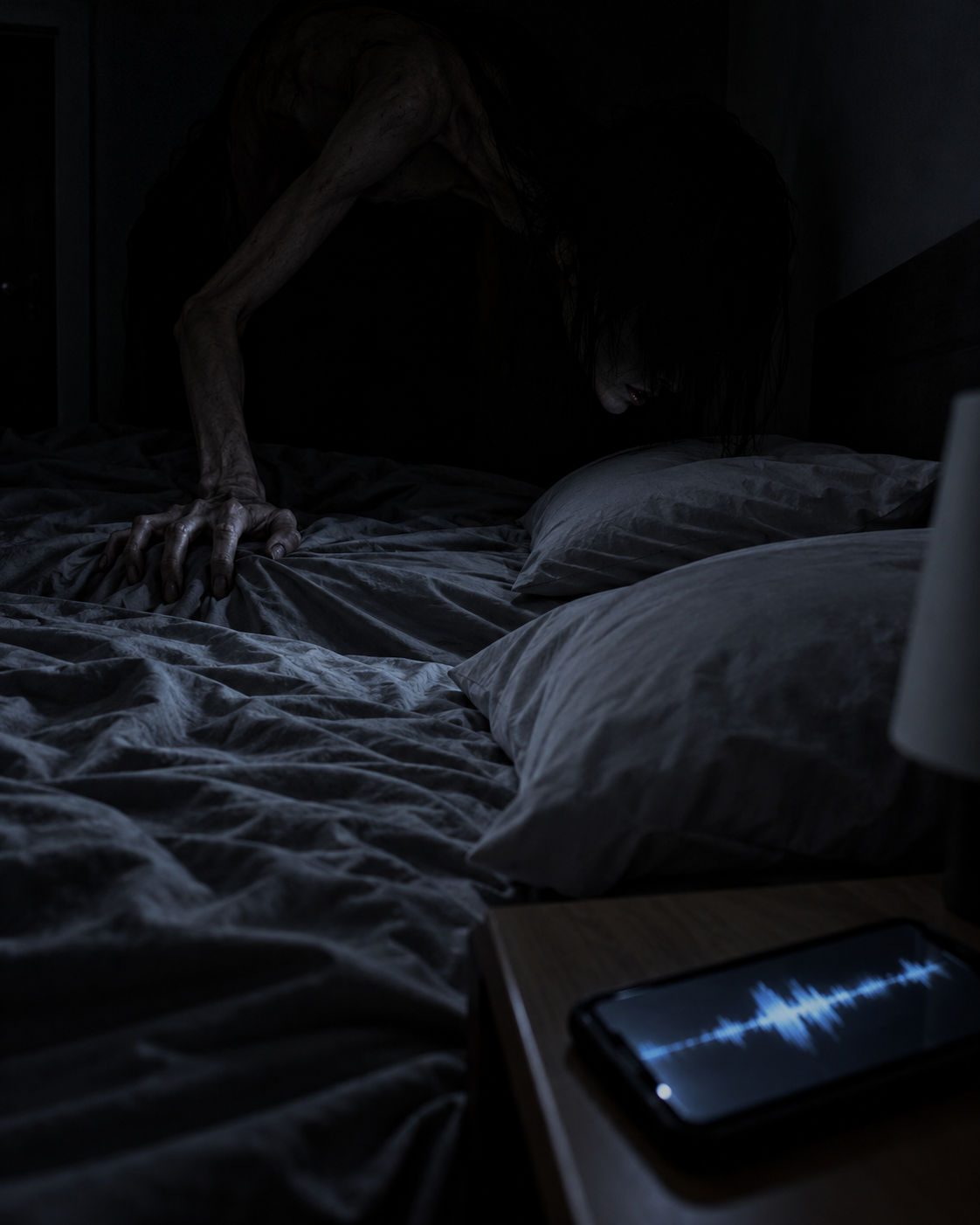
October 29 — Day 29 of the visual horror writing challenge
You download a sleep-recording app because you want to know whether you snore.
The first recording contains a fan humming, sheets rustling, and your own uneven breathing.
Then someone beside the microphone whispers a number.
Another breath.
Another number.
You live alone.
This sleep horror writing prompt begins with evidence of something your character slept through. Tonight, they’ll have to face it awake.
The Next Breath: Your Writing Prompt
Your sleep app records a stranger counting each time you exhale.
The counting stops at 312, just before your alarm.
At work, you listen again with headphones.
Beneath the stranger’s voice, you hear yourself whisper:
“Please. I can stay awake tomorrow. Let me have this one.”
You have no memory of saying it.
That night, you sit upright with every light on.
At 2:13 a.m., the mattress sinks beside you.
“Three hundred and thirteen.”
Let the Recording Establish a Pattern
Make the first few seconds ordinary.
Your character hears the bed creak when they turn over. A car passes outside. They recognize the rattle of their fan.
Then introduce the counting.
Keep the voice consistent enough for your character to test what they’re hearing. It speaks after each exhale. When they pause between breaths, it waits.
The recording becomes more frightening as their explanation grows more precise.
Someone was close enough to hear them breathing. Someone remained there for a long time. And sometime during the night, your character knew it.
Make Their Own Voice Unfamiliar
The whispered plea provides evidence of an encounter they cannot remember.
Think about how they sound.
Perhaps they speak with the careful patience of someone calming a dangerous animal. Perhaps their voice is hoarse from repeating the same request.
Give the reader one detail that suggests this has happened before.
Your character might hear themselves say, “You promised,” before the counting resumes.
Avoid revealing the whole arrangement. Let the character understand just enough to dread bedtime.
Give Them a Credible Plan
Your character has hours to prepare.
They could ask someone to stay, leave the apartment, set up a camera, or sit beneath bright lights with the recording running.
Choose a plan that fits their circumstances and let it help temporarily.
If they stay with a friend, the first part of the night passes quietly. Then the friend asks why they keep muttering numbers.
If they set up a camera, it shows an empty room. The audio still captures the mattress springs compressing.
Each attempt should reveal something about the threat. Keep the discoveries connected so the danger feels consistent.
Make Breathing Part of the Scene
Once the visitor arrives, an ordinary bodily action becomes something your character cannot ignore.
They try holding their breath. Their chest tightens. They release a small amount of air through their nose.
The voice counts.
Now they know it can hear that too.
Use physical detail sparingly: a trembling jaw, damp palms against the sheets, the effort of swallowing without making a sound.
Let the reader feel the time between numbers.
Decide What the Count Means
Know the answer yourself, even if the scene ends before your character discovers it.
The visitor might be measuring how long a body lasts. It might need a certain number of breaths before it can use the lungs itself.
Perhaps the count belongs to something elsewhere, and your character’s breathing is keeping it alive.
Choose an explanation that shapes the visitor’s behavior. Does it become impatient when your character holds their breath? Does it lean closer? Does it begin breathing for them?
Your Horror Writing Exercise
Write 400–600 words beginning with the mattress sinking.
Keep your character awake throughout the scene. Reveal the visitor through sound, pressure, and its effect on the room before describing its appearance.
End when the count changes in a way your character understands.
What happens at the final number?
Share your opening line or your theory in the comments.