The Missing Hour: A Small-Town Horror Writing Prompt for October 22
A jigsaw puzzle seems like a fairly safe evening activity.
Make some coffee. Find the edges. Spend twenty minutes insisting a piece must be missing before discovering it under your elbow.
Then you recognize someone in the picture.
For day 22 of our October horror writing challenge, we’re putting a small-town secret on the kitchen table, one piece at a time.
The Writing Prompt
Last Thursday, everyone in your town lost the same hour.
No one remembers where they were between 8:13 and 9:13 p.m. Nothing seems to have been stolen. Nobody is missing. Eventually, people stop discussing it.
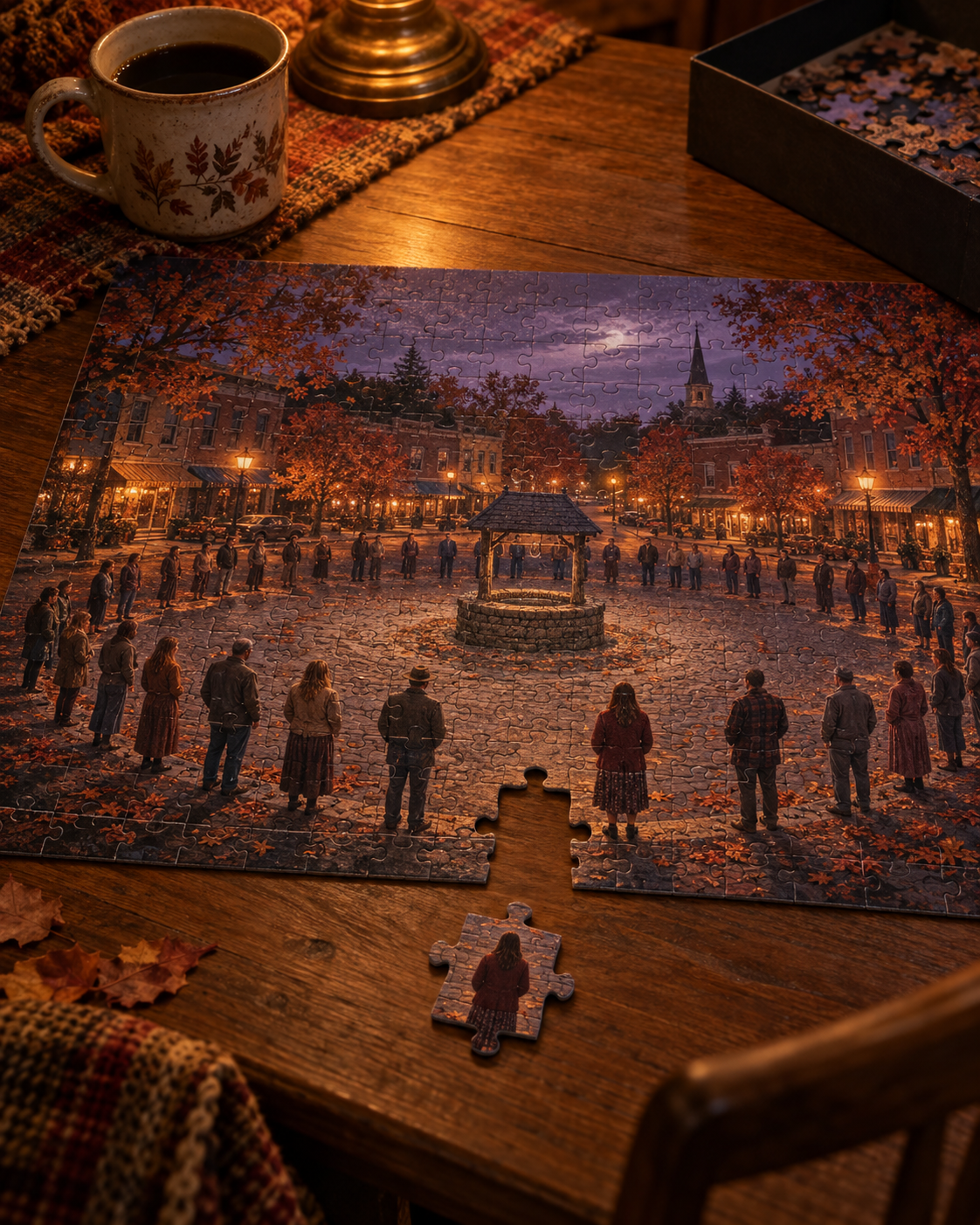
Then you open a secondhand jigsaw puzzle.
The picture shows your town gathered around the old well at night. You recognize your neighbors, your family, and the clothes they wore last Thursday.
One piece remains.
It shows you standing in the circle.
On the back, in your handwriting, are four words:
“Don’t let me remember.”
Let Recognition Build Slowly
Your character shouldn’t understand the whole picture immediately.
Start with a familiar landmark: a particular roofline, the crooked clock above the hardware store, a tree that split during a storm.
Then let them find a person.
A red scarf might catch their attention first. Their neighbor owns one just like it. Nearby, a tiny painted figure has the same walking stick as their father.
Recognition gives the scene momentum. Every piece answers one question while making the next harder to ignore.
By the time your character recognizes their own clothes, the reader should be leaning closer too.
I would already have pushed my chair back, but I’d probably still be looking. Curiosity is an unfortunate quality to bring to a haunting.
Give the Missing Hour a Practical Consequence
Think about what people noticed afterward.
Someone’s dinner burned. A dog escaped its yard. A driver found their car parked several streets from home.
Choose one small consequence your character has been unable to explain. Then place evidence of it inside the puzzle.
Perhaps the escaped dog is standing beside the well, calmly watching something the people cannot see.
That connection makes the picture harder to dismiss as a coincidence or a cruel joke. It also rewards the reader for paying attention.
Make Remembering a Difficult Choice
“Don’t let me remember” raises a useful question: what did your character know when they wrote it?
They may have chosen to forget something unbearable. They may be protecting someone. Perhaps remembering carries a consequence beyond fear.
Give them a reason to continue despite the warning.
Someone they love appears in the picture holding a shovel. Their child stands dangerously close to the well. A person who supposedly moved away years ago is among the crowd.
Now your character has something to lose by leaving the puzzle unfinished.
Let the temptation be specific. We should understand why they pick up that final piece, even while wishing they would put it down.
Use the Puzzle as a Physical Object
Keep returning to what their hands are doing.
A thumb rubs the worn cardboard edge. A coffee cup leaves a damp ring beside the picture. The final piece fits so neatly that your character presses it into place before thinking.
That ordinary little movement can carry the scene’s biggest consequence.
You could also let them try taking the puzzle apart. What happens when they remove a neighbor’s face? Does the phone ring? Does someone knock? Does the space remain empty when they look again?
Choose a rule and follow it.
Your Ten-Minute Writing Challenge
Write 300–500 words beginning when your character recognizes the first person.
Keep the scene at the table. Let the missing hour emerge through details in the picture and your character’s reactions.
End with their decision about the final piece.
Would you finish the puzzle—or trust a warning you don’t remember writing?
Tell me in the comments. I’m suddenly feeling very comfortable with leaving a project unfinished.